Check the Existing Food Before Writing a Meal-Prep Shopping List
An inventory can prevent duplicate purchases only when it records usable food and actual storage history. Check the refrigerator, freezer and cupboard before planning the batch. Do not make use-it-up pressure a reason to serve questionable food.
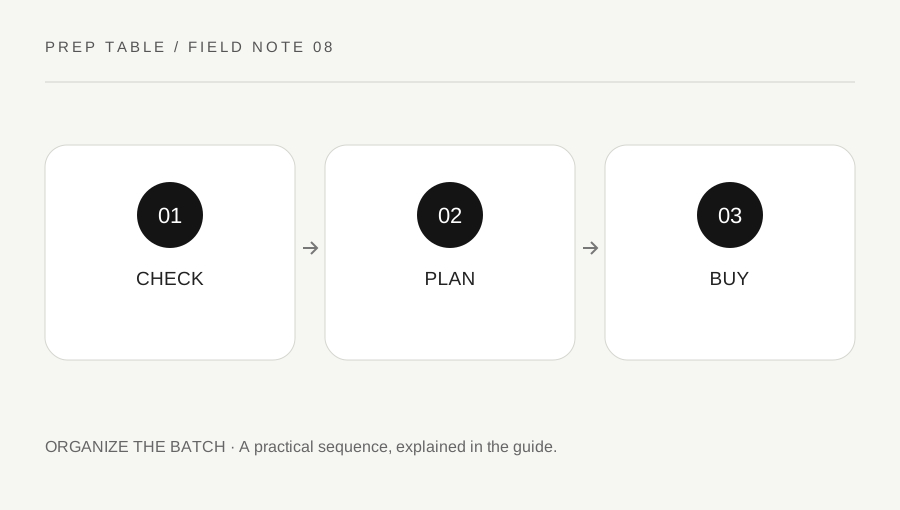
Original explanatory diagram. Examples illustrate a method or decision; they are not claims of personal testing.
List what is actually present
Use plain food names, amounts or approximate usable quantities, and relevant dates. Distinguish unopened shelf-stable products, opened products, raw ingredients and prepared leftovers. A cupboard entry saying beans is less useful than identifying ready-to-eat cans versus dry beans.
Check actual labels and storage conditions. Do not assume an ingredient is usable because the inventory says it was bought recently. If history or condition is uncertain, follow appropriate official and product guidance rather than planning it into a meal automatically.
Choose supported meals from usable components
Select suitable recipes or assembly methods that match the ingredient states you have. A recipe for cooked chicken cannot treat raw chicken as the same ready component. Keep cooking, cooling and reheating needs attached to the actual ingredient.
Avoid choosing several complicated recipes solely to consume every remaining item. A smaller plan can be easier to prepare and store appropriately. The goal is a realistic batch, not a promise that one list will eliminate all waste.
Calculate the missing quantity
Write the recipe's required amount, the usable amount already available and the difference to purchase. Keep units and ingredient states consistent. Subtracting a cooked amount from a dry-ingredient requirement is not a valid inventory calculation.
For an illustrative example, if a supported plan needs 600 grams of a ready component and you have 250 grams that is appropriate to use, the missing amount is 350 grams. Product package sizes can create a second decision about purchase quantity and later use.
Check storage and equipment capacity
Before buying for a larger batch, confirm that the refrigerator, freezer and suitable containers can support safe cooling and storage. A sale quantity is not useful if the planned process leaves food waiting under unsuitable conditions.
Check the actual cooking equipment and recipe scale too. Doubling ingredients does not automatically validate a crowded pan or a new baking depth. Use supported quantities and methods, then plan any remaining ingredient separately.
Update the inventory after preparation
Record what was used, what remains and the actual preparation or opening dates. Remove consumed entries so the next list does not count food that is no longer there. Keep labels on new meal containers consistent with inventory names.
Review the plan after a real week and note which quantity estimate was inaccurate. Do not rewrite the original list to make it appear exact. A practical inventory improves through honest observations while food safety remains based on real handling and relevant guidance.
Add a purchase-size line after calculating the missing amount. If the plan needs 350 grams more of a suitable component but the selected package contains 800 grams, the remaining 450 grams needs its own appropriate use and storage plan. Do not count that remainder as prepared lunches before it has been handled through a supported process. A smaller package, another recipe or a reduced batch may be more manageable. Keep raw and ready-to-eat states distinct in the list. After shopping, update actual quantities rather than leaving the intended purchase as though it definitely occurred. The inventory then describes real food and conditions, making the next calculation easier to audit instead of accumulating optimistic entries.
A practical checklist
Choices are saved in this browser. Reset them here or clear this site’s browser storage.
Questions that come up
Should every leftover be used to avoid waste?
Not if its safe history or suitability is uncertain. Follow official and product guidance rather than letting use-it-up pressure override safety.
Can I subtract cooked grain from a dry-grain shopping requirement?
Not directly. Convert only with an appropriate clearly stated basis or plan using matching quantity states.
Does a sale justify doubling the batch?
Check supported recipe, equipment and storage capacity first. A purchase opportunity does not validate a larger process.
References & scope
Background references checked on 18 October 2026. Worked examples and diagrams are original teaching material.